The first three boats listed are boats that I grew up on, owned either by my parents or my grandfather. The remainder trace my wandering path of boat ownership that changes with my interests combined with family requirements. At the end of each description, I include the key lessons each boat taught me.
The Lyman-1948 13′ Lyman
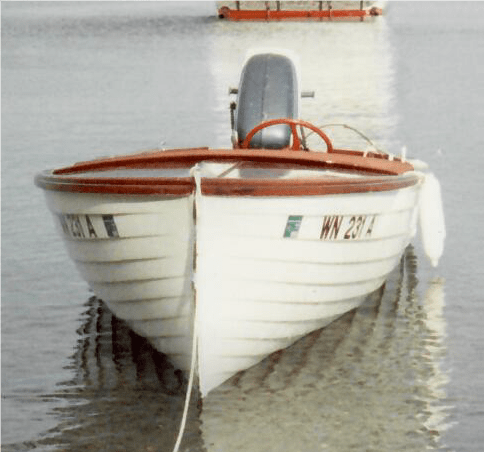
It would be hard to overstate the number of hours I have spent in this little boat. Purchased by my father in 1960 it was still relatively new at the time. Motorless, he installed a 1958 Evinrude Big Twin (two- cylinder 35HP). This got a decent speed in the low 20’s. We still have this boat, now 73 years old, carefully restored, residing on a new trailer and stored away. It occasionally comes out for the local boat show.
Lymans are not super common in our part of the country but growing up it seemed like most people knew of them and the quality and story behind them. The look and finish of the Lyman boats obviously left an imprint on me. Two other boats on this page are also lapstrake boats and from an appearance standpoint, they are still my favorite.
Growing up, I wanted to be able to drive the boat in the worst way, but my father’s rule (and a good one) was you had to be able to start the motor. Now electric start was for other people, our Evinrude was a pull start and the compression those two cylinders created was not insignificant. I am not sure how old I was when I could finally get that beast started, but I was driving a boat long before I could drive a car. I still love to drive a boat, regardless of speed, and the smell of two cycle exhaust brings back many excellent memories.
Simply known as “the Lyman” in our family, it took us camping, a little fishing and a lot of waterskiing on saltwater and fresh. There are hours and hours on that Evinrude and other than the cowling, I am not sure how much of the motor is original. It would run, occasionally break, go to the shop and come out to run again. The amount of abuse 5 kids heaped on that boat is a testament to the Lyman craftmanship. Use of the Lyman slowly tapered off as we all left home. Some left the area and some bought different boats until eventually it sat unused. Finally, one winter, I brought it into the shop and peeled layers of paint off to see exactly what we had after 60 years of use, abuse and finally neglect. Once I realized it was long overdue for a major restoration, I brought my father in to discuss. I had two other boats, three kids, a job and no additional time for a major restoration even on a small 13’ boat. After some discussion it was decided to cut it up and toss it in the dump. The boat sat in the shop for a couple more weeks and I just worked around it. My Dad came by one day and surprised to see the boat still there, asked why I hadn’t disposed of it yet. I confessed, I couldn’t do it, he would have to. The boat sat there for a while longer-same problem for him. Finally, the decision was made to take it to Jensen Motorboat on Lake Union in Seattle (now closed). They put it in one of their lofts and worked on it whenever they were slow during the winter months. After two winters, it finally emerged looking brand new. Key Lessons: 1.Simple breaks less. 2.Check the screw clamps that hold the motor to the transom (don’t ask) 3. A good boat is worth keeping if you can work it out.
The Raven-1954 24′ Raven sailboat-more info soon
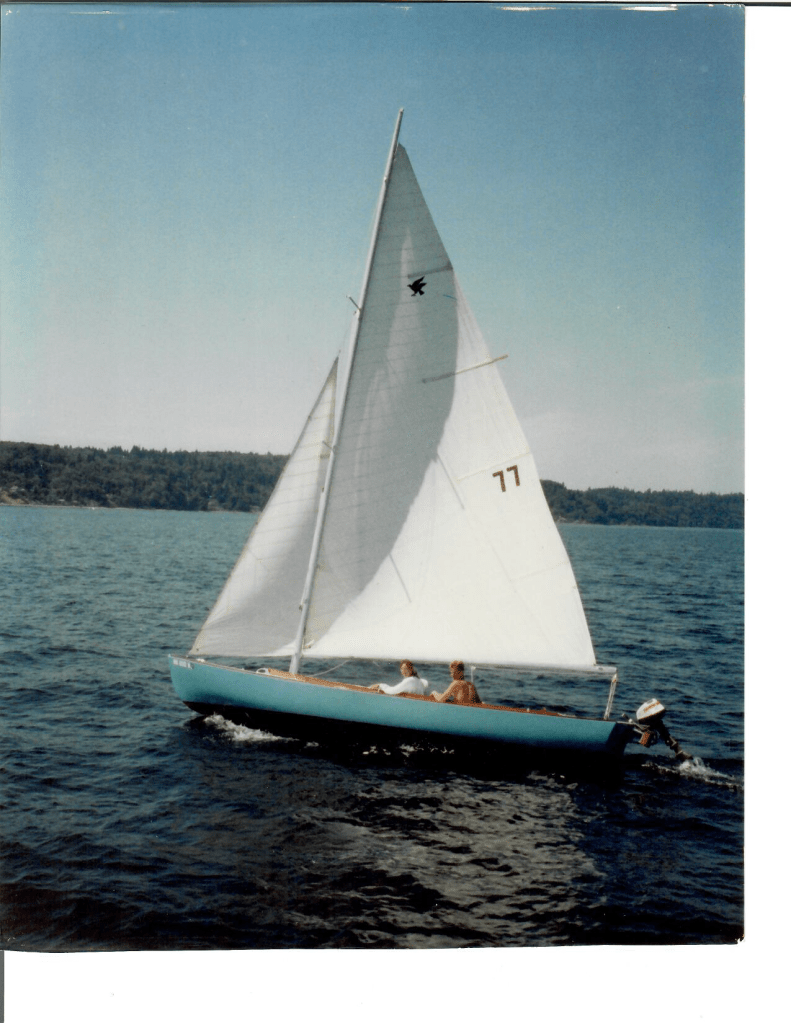
The Raven (class) is an American trailerable, centerboard planing sailboat that was designed by Roger McAleer and first built in 1949. The boats are still being built (now in fiberglass) by Cape Cod Shipbuilding Company. The original boats were built of cold molded plywood. Ours was home built including a home-built trailer that was welded up out of steel pipe. It looked rough, but it never let us down. The Raven was essentially a large sailing dinghy, lots of fun, very fast, very wet and very cold. My favorite sailing was with a strong wind and the lee rail in the water while we stood on the centerboard trunk. However, I never quite caught the sailing bug and I found I much preferred the power-cruising lifestyle to the sailing-cruising lifestyle. That said, I did spend a fair amount of time sailing the Raven-any day on the water is a good day and some days that was the only or best option. This boat, much like the Lyman, was well used by our family until it needed more than a seasonal coat of paint and varnish. Around 2015 the Raven went up to Jensen Motorboat on Lake Union in Seattle (now closed) for a winter of serious refurbishment. Once completed it returned to my Dad’s house to sit on its trailer and never be relaunched. Eventually in 2019, through a family friend, my Dad found someone up in Port Townsend who promised to love and take care of the Raven so he happily signed over the title and the Raven would get back on the water again. Key Lessons: 1. Sailing is not my thing, but it is still fun. 2. Going in a straight line to your destination is better than zig-zag.
Cee Pee V-1965 36′ Fairliner Sun Bridge Tri-Cabin:
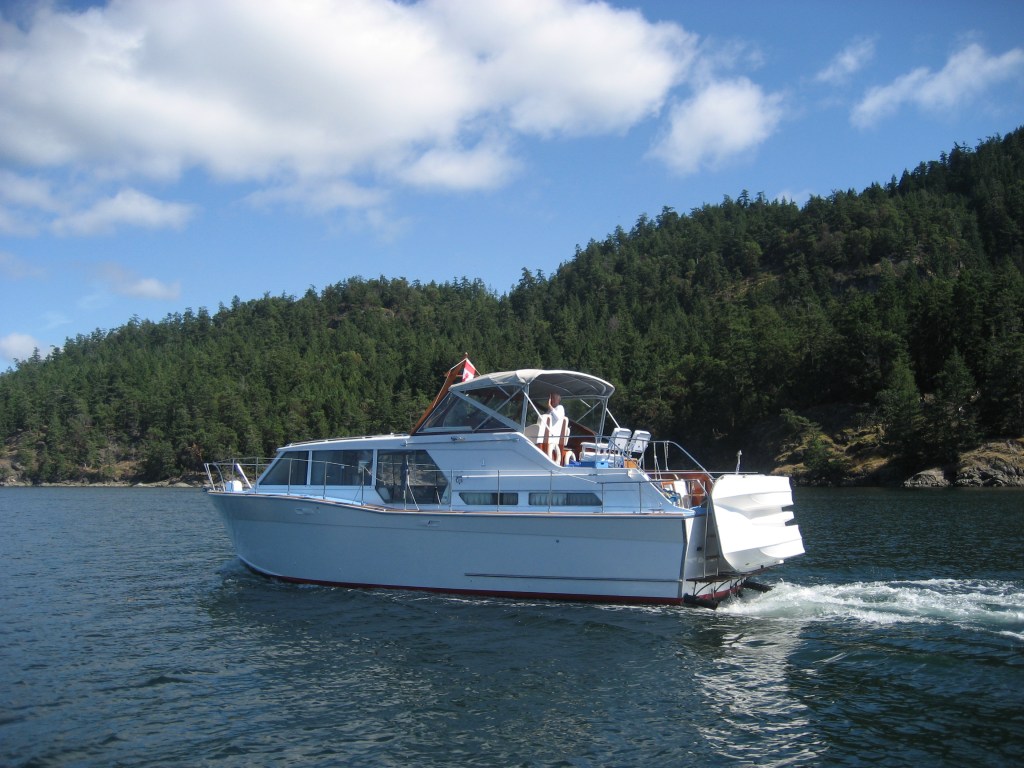
My grandfather purchased this boat in 1970 when it was only 5 years old. He had a 32’ Fairliner and I can only assume he was looking for a little more space. The 32 was a fast boat for a cruiser (Fairliner’s best model in my opinion) but his 36 never really performed to expectations. Underpowered, wide and heavy, as throttle was applied it dug a large hole in the water and consumed copious amounts of fuel with little speed in return. When he bought the boat in 1970 fuel was still cheap, but the 1973 oil embargo put a damper on that with high fuel prices and fuel shortages. However, he never sold the boat and eventually it passed along to my father who kept it until about 2010. As a high schooler in the early 80’s I have good memories of my grandfather tracking me down in the summer and we would run the boat down to Tacoma (slowly) to “get gas” even though we passed up a perfectly good fuel dock in our own marina. Once out of the tight spaces he would relax in a deck chair while I would run the boat. During the winter he paid me $10.00 a week to keep an eye on the boat, run the motors and make sure the systems were functioning. Each spring found me under the boat sloshing on more bottom paint. Once my grandfather was gone (shortly after our first son was born) my dad was generous with the boat and let us use it for day and weekend trips. After we purchased Jonta, we had some very enjoyable trips cruising alongside my parents. Both boats built the same year representing the decade beginning what I call the “fast cruiser”. A boat with overnight accommodations that up until then had been relegated to slower displacement speeds, could now get up on a plane (in theory) and move you from point to point much quicker than 7-8 knots. In the 40 years our family owned the CeePeeV I spent a lot of time with that boat. Many hours of maintenance, systems and engine upgrades etc. It made me a huge fan of the Fairliner boats and it is sad that you rarely see one these days. My father had the boat completely redone in about 2006 but he shortly thereafter bought a new boat. He held on to it for a few more years hoping one of use kids would take it over but I had a boat and no one else had the interest so it was eventually sold. I saw it a few months ago, looking well cared for in Gig Harbor WA. Key Lessons: 1. Twin engines are easier to maneuver than one. 2. Good care and maintenance can compensate for a vessel’s weaknesses. 3. Boats bridge generations.
Willow– 1928 One-off, Double-ender
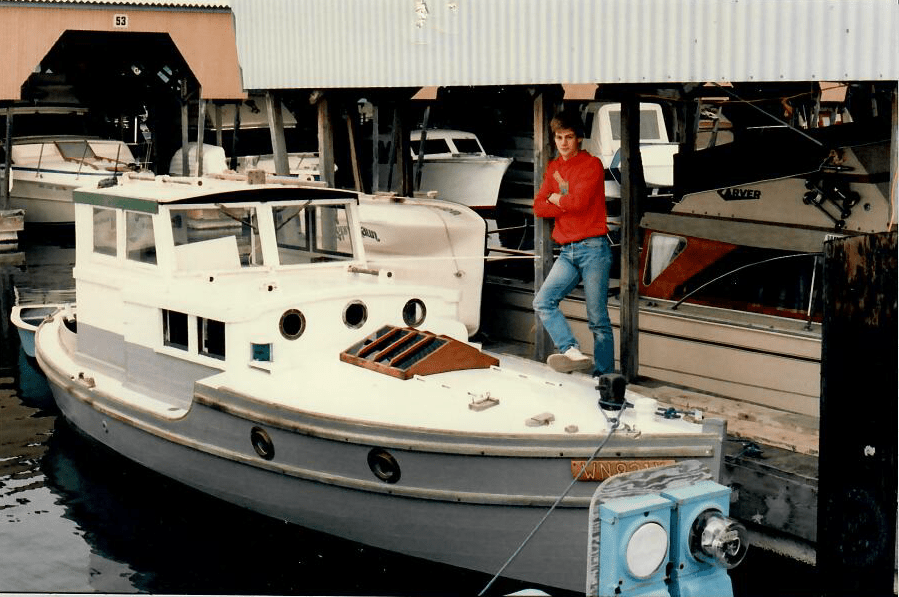
This is the first boat I owned. A one-off double-ender built in British Columbia in 1928. 26 feet long with a beam of 6.5 feet-narrow and round, she did roll quite a bit. Powered by a single cylinder Easthope engine she chugged along at about 6 knots. Her original configuration did not have the wheelhouse, apparently it was added in the 70’s. There was a mast at some point but I think it was more to slow the roll than anything else and it was gone when I bought the boat in 1984. I was in high school and most guys were working on old cars-I was the only one with an old boat. My dad had seen Willow sitting blocked up in the front yard of a house across from Fisherman’s Bay on Lopez Island, WA. Five years prior she had broken free of her mooring, drifted to the shore and laid over when the tide went out. She did not refloat but filled and remained on the bottom. The owner had her refloated, hauled out and trucked to his front yard where she sat until my dad saw her one summer. When the conversation started about me buying a car, Dad suggested a boat might be more interesting… I really think he was just trying to keep me off the road as much as possible. My driving record wasn’t stellar at that point. Some negotiating, followed by a long weekend of DIY boat moving (not sure why the boat didn’t fall off on the interstate) Willow was safely tucked into a shed on my Grandmother’s property. There it stayed for the next year why I grappled with a steep learning curve. I started working after school and on the weekends at the local boat yard and my boss was incredibly helpful as I worked my way along. I also had a shop teacher who was a bit of a boat nut and let me do boat projects instead of the standard bird houses and checkerboards that tended to be the standard fare in high school shop. I was able to get the boat launched and occasionally running the summer after my senior year. I spent a year at the local community college so work could continue, but after that I was off to the state college 3 hours away. That doesn’t sound like a long distance, but I did not have a car so I had to catch a ride or take the bus. The boat was in uncovered moorage and by the time I returned full time the next summer I had taken a few steps back in my progress. By the end of the summer, I had caught up, but was not able to move forward. The next year followed the same pattern and I realized I needed to pass the boat along to someone with more time so I put her up for sale. I learned a lot in those three years and the $2500 dollars from the sale enabled me to buy an engagement ring…and that has worked out remarkably well. I last saw Willow up in West Sound on Orcas Island (Washington State) 25ish years ago. If anyone has any info, I would love to know what happened to her. And yes, that is me in the photo at about 18 years old. And no, I don’t look like that anymore! Key Lessons: 1. Boat people are helpful, just ask. 2. Keeping a wooden boat outside is tough sledding.
About Time 1958 18′ Thompson runabout:

My wife and I got married in August of 1989 and for a couple of years we were too broke to fit a boat into the budget. I found this Thompson sitting in someone’s driveway looking very ignored with a faded “For Sale” sign. Price was $500.00 but we could not afford that either. So we went into partnership with friends of ours and dragged the boat home in the fall of 1993. That winter we cleaned up the boat, replaced portions of rotted deck, varnished and painted. The big question was would the 1960 Evinrude 75HP Starflite II actually run. We scraped together some money and took it down to the local marine mechanic who, in my opinion, was a bit of a magician. He waved his magic wand and run she did. So we launched her that first season and discovered we had some sort of problem. At higher speeds the bow dove down and the boat was impossible to keep on a straight line. We did not really understand the problem. Now remember, this was before the internet was the resource it is today so most of our work had to be done via the phone, during the day, while we were all working. And we did not have cell phones. We eventually came in contact with Dave Lobb of NW Classic Boats who, at the time was located on Mercer Island, WA. (Note: Dave has now retired but NW Classic Boats carries on in Northern California under the guidance of Rudy ) Dave was generous with his time and advice and obviously recognized a shoestring operation when he saw one. We dragged the boat up to his shop where he looked it over. He quickly diagnosed the problem. The trailer was short and about 12 inches of boat hung off the back. Over the years the stern of the boat had sagged about 1/2″ and essentially created a wing that drove the bow down when she was up on a plane. Dave’s recommendation: Put sand bags in the back under the rear seat, leave it in the water all summer to soak and use it, fix the trailer, haul it in the fall and with the transom properly supported load more sand bags inside to slowly take the bend out. That worked pretty well. We never got it out completely, but things were much improved by next year. Over the next two years we camped, we fished, we repaired 28 cracked frames, replaced portions of stringers, and found a better motor, but I was starting to get the itch to build a boat and the Thompson was sold. Key Lessons: 1. Boat people are helpful, just ask. 2. Do your research, then act. 3. Lapstrake (clinker) built boats are not that hard to work on. 4. A good mechanic is a god-send.
Sea Dragon-1997 20′ Tolman Skiff:
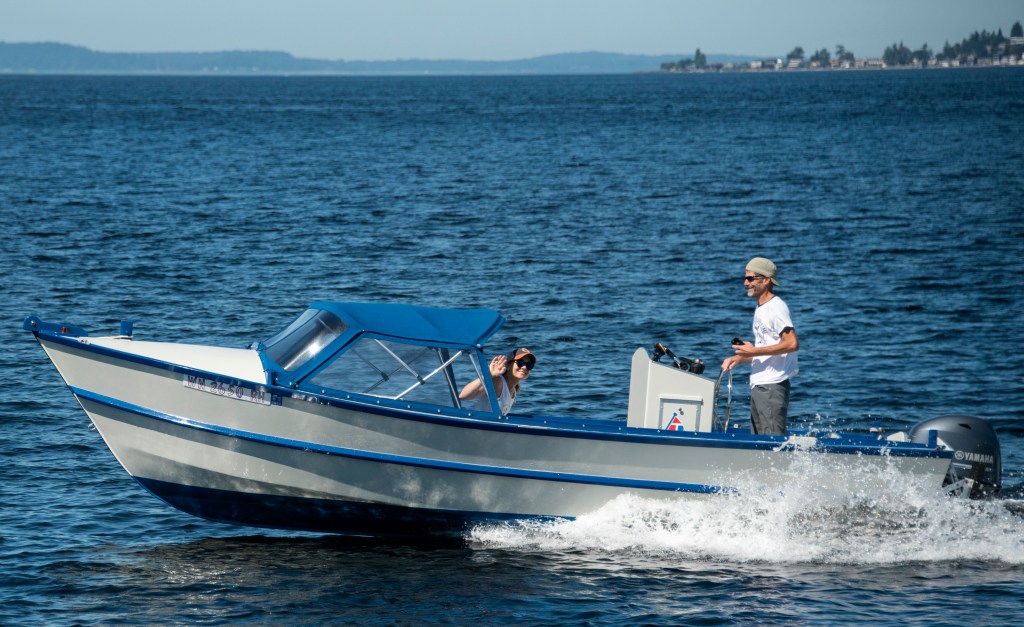
We still own this boat. Three motors have hung on its transom with the latest being a 70HP Yamaha. I have remodeled the interior three times and this photo is the latest version done during the Covid lockdown. The stitch-and-glue constructed Tolman Skiffs have developed quite a following since we have had this boat. When I started on this project there was an 18′ version and a 20′ version. I did the 20′. Now there are versions up to 24′ (If you are interested in the Tolmans, start with tolmanskiff.com) Using Renn Tolman’s book A Skiff for All Seasons I was able to work my way through the project in about 18 months. The original design was basically an open boat. I knew I wanted something a little different. So I used the bow design of the St. Pierre Dory, and the general interior layout of the Simmons Sea Skiff. A canvas cuddy keeps passengers out of the weather, but the helmsman better be pretty tall to see over it. We have used this boat for fishing, camping and general running around for the last 24 year and it performs very well in all sorts of weather. The dory style allows loading down with people and gear but still gets up on a plane and cruises right along. Empty she is light and will pound if you try to drive into a chop, but slow down to about 15 knots and she will ride nicely. With the motor up, she only draws about 12″ and you can float into the beach, but I have also slopped through 4-5′ waves a few times. The first motor was a Johnson 1985 V-4 115HP which was way to much power. Once that one wore out, I found a Johnson 1984 V-4 90HP which was convenient as I didn’t have to do much reconfiguring to make the swap. That one lasted until 2019 when it gave up and I switched to the 2020 Yamaha 70HP 4-stroke. Trust me, jumping from 1984 2-cycle to 2020 4-cycle is pretty amazing. Key Lessons: 1. Boat people are helpful, just ask. 2. Do your research, then act. 3. It is worth it to get up at 2AM to lay on another coat of epoxy in the “green state” rather than let it dry and sand it. 4. A good boat is worth keeping if you can work it out.
Three’s A Crew– 1978 26′ Skiffcraft:
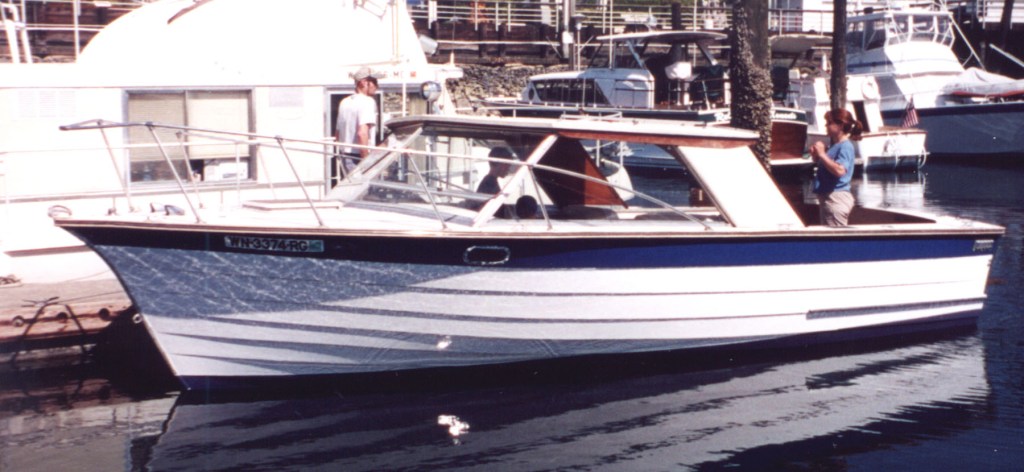
After 4 years of beach camping out of the Tolman, we felt our family of 5 needed some more room, and the ability to travel further. I had always wanted a Lyman Cruisette, but they were always out of reach financially. When I started to look around for a larger boat, I came across a similar layout within the Skiffcraft (if you are interested in Skiffcrafts go to skiffcraft.com) which did not command the same price as the Lyman. For those not familiar with this layout, starting at the bow: enclosed v-berth with porta-pottie under. Under the hard top on the starboard side is the helm followed by a galley cabinet with a sink. On the port is a dinette which folds out into a berth. Across the stern is a full width seat which hides the engine and outdrive. This boat was a bit of a wreck. It was in the water on Lake Union and a survey showed that she had significant rot below the waterline. But, I had wanted one of these boats for a long time, so we bought it in February of 2001. I trucked it down to the shop and set it up outside under some tarps. The good news was that the engine was solid, that was about it. After a winter, a summer and a second winter, I had removed and replace 80% of the structure below the waterline. Including keel, planks frames. Rebuilt all the interior cabinetry, varnished, painted, sorted the elctrical and rebuilt the outdrive (with help). We used the boat one season and realized we had outgrown the boat before we had even bought it. So I sold it to a fellow on Lake Minnetonka in Minnesota. Key Lessons: 1. Boat people are helpful, just ask. 2. Do your research, then act. 3. When you are discouraged, take action. 4. Cut your losses and move on.
Jonta-1965 28′ Grandy Express Cruiser:

This boat was part of our family for 18 years. Our youngest daughter was 5 old when we bought it and was finishing her masters degree when we sold it. Jonta was Grandy Boat Company’s floor model for the 1965 Seattle Boat Show. She was sold to Jon and Rita Wolfe for $9800.00. The Wolfes took her up to Everett and put her in a boathouse where she remained until we purchased her in March of 2003. We purchased her from Cliff and Harriett Duncan and co-owner William Olson who had bought her from the Wolfes in 1988. Jonta was a real cruising boat and took us that first summer to the Gulf Islands in BC. That marked 18 consecutive summers with Jonta that we would cruise the waters between the Gulf Islands and Desolation Sound. Jonta was nearly original when we purchased her. The vinyl cushions in the V-berth and dinette has been replaced with cloth, a depth sounder had been added and a full “camper” canvas that covered the entire back deck and seating. We tried to keep that original 1965 feel with every update we did. When we replaced the engine and tanks, we painted them the baby blue that was the original. Probably the only blue Chevrolet 350 in town. When we added a 110v system so we could have a battery charger the panel and every outlet was hidden in a cabinet or generally out of site. When the canvas and paint cabin tops failed, I installed dynel cloth set in epoxy with rechromed original hardware. It looked no different. When I had to redo transom I carefully took patterns of the name, and a sample of the color and after 10 coats of varnish, the name was hand painted back onto the transom and covered with more varnish, just as done originally. It would take far to long to try and recount all the memories, projects and miles traveled in this brief description but this boat was woven into the fabric of our family. So how did we come to the decision to sell her? In May of 2019 we were returning after 3 weeks running up to Chatterbox Falls, the Gulf Islands and some time with friends in the San Jauns. It was just my wife and I, kids all out on their own now. We were discussing how to extend our cruising range and Jonta did have some limitations when it came to range and weather. For the first time, I was considering a major structural modification which would be a complete departure from the “keep her original” mantra. My wife was considering a different problem. We were sitting at the dinette and she remarked “This boat has too many good memories”. I was confused since she stated it in a way which indicated this was not a good thing. “It just reminds me of all the fun times with the kids when they were growing up and now they are gone.” So, both of us,in our own way had arrived at the same conclusion. It was time to move on to the next boating adventure. Key Lessons: 1. Boat people are helpful, just ask. 2. Even slowly, times change-acknowledge it and 3. Stepping forward into the future is ultimately easier than clinging to the past.
Grandy-1972 Grand Banks 32′ (current boat):

Our last boat (see Jonta) had taken care of our needs quite well, which is one of the reasons we did not feel a desire to make a change for so many years. Of course, from time over the years we would discuss other features we would like to have. Once we were committed to making a change, we dusted all those conversations off and started to whittle them down to the critical items. Here, in no particular order, are the major items we focused on and ultimately found in the Grand Banks 32:
- Passenger capacity-Overnight and longer trips would typically just be the two of us, but day trips would need to accommodate more.
- Length-Overall length around 36 feet- several reasons for this, one is moorage. The longer the boat, the harder (and more costly) it is to find moorage in our area. Second, I just think that we can do what we want for cruising in that size of boat and added volume is not necessarily added benefit. And finally, I do single-hand pretty frequently and I was not sure I could deal with much more boat by myself. Especially with a single screw boat and not a thruster to be seen. Our GB32 has a length overall of 36.5 feet.
- Mass- this was a big change. After years of cruising along in a semi-planing hull at 13 knots we had decided we wanted the weight and seakeeping ability of a displacement hull. The big trade-off is speed (with the add back of much lower fuel consumption. We went from 7500 pounds to 18,000 pounds so a lot more stability when the waves kick up, but we now cruise at 7 knots. So far this is much more relaxing…and much quieter!
- Flybridge- We had always cruised under a hardtop and we knew we wanted the option to sit in the sun. Our flybridge has no bimini so it gets plenty of sunshine and allows space for day guests to lounge. It is also a great vantage point to watch the world go by when moored.
- Designated spaces-Many boats have spaces that have more than one use. (For example, the dinette that converts into a berth.) This can be fine as long as the persons aboard don’t need the same space for different uses at the same time, we wanted to keep this conflict to a minimum. We were looking for the following designated areas: Helm station, head/shower compartment, sleeping quarters, galley, interior lounging, exterior lounging. The GB32 gives us all of these with the ability to sleep the occasional two more in the salon. The stateroom closes off so that my early morning coffee making doesn’t disturb Julie.
- Ease of handling: Having spent time on other boats with wide walk-around decks behind bulwarks and rails, we realized how much easier this made the handling of lines, fenders and anchor. The GB32 has a low bulwark with a rail extending above. The decks are wide with only one step at the back of the cabin to the rear deck. You give up a bit of room in the cabin, but we find the trade-off worthwhile.
- Extended range: We wanted more water, more fuel, more electrical storage. We have gone from 30 gallons of water to 100 gallons, from 110 gallons of fuel (range of 188 NM) to 240 gallons (range of 672NM) and from a single Group 30 house battery to 6-6 volt deep cycle batteries.
- And finally, it had to be wood.
One of the challenges with wood is that the boats are (typically) old, old engines, old electrical, old plumbing etc. However, good care through the years can mitigate the aging process as well as the “type” of owner. Some people consume their boats, others improve. Most boats, if they pass through enough owners will get a bit of both. The trick is to find one who has had more of the improvers. I was expecting to have to do some work, but wanted to find one that could be used during the cruising season and projects could be done during the winter months. The internet is a great way to cut down on the number of boats you have to look at in person and we were able to keep the in person viewing to a minimum. Unfortunately, the one we were most interested in was in Sidney BC which, due to Covid was off limits. We continued our search along the West coast but were unable to find “the one”. So we returned to looking at the Sidney listing and ultimately did the unthinkable and bought the boat after only viewing it by video and photo. Has there been a few issues to resolve what our inspections did not reveal? Sure, but we expected that and overall…we are pleased. Key Lessons: 1. Boat people are helpful, just ask. 2. A little change and a little risk can be good.
 Todd Powell Boats