
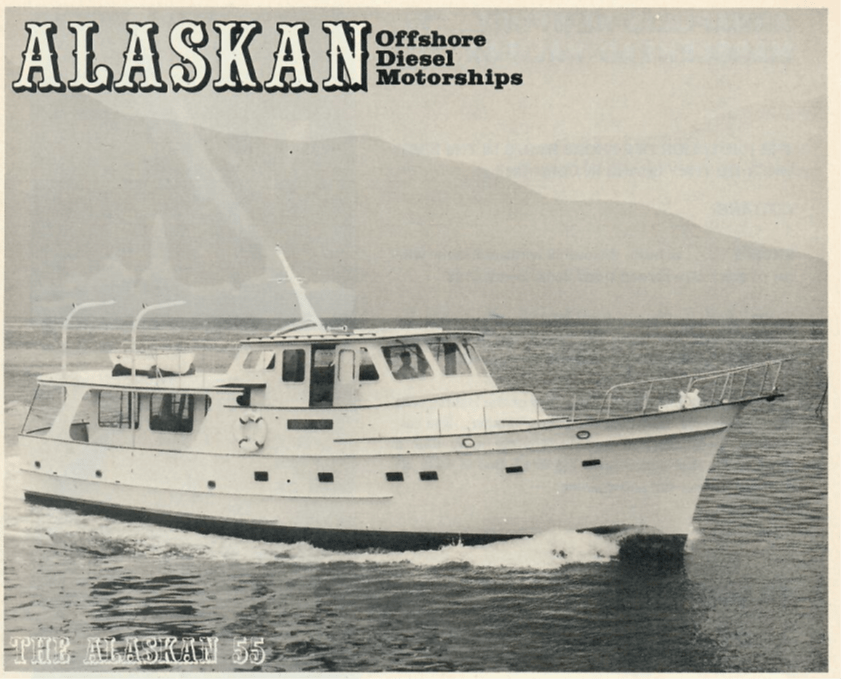
The American Marine Alaskan-a brief history
Sources: Tony Fleming & PassageMaker Magazine
Today you will frequently see a “Grand Banks Alaskans” for sale. However, in the 60’s and 70’s would have been a bit confusing as it combines two of three model lines produced by American Marine Ltd., “Grand Banks” , “Alaskan”, and “Laguna”. It would be more accurate to say “American Marine Alaskan” but not many people would know what you are referring to.
The Alaskan models were introduced into the American Marine Product line in the late 60’s to give buyers an alternative to the standard Grand Banks offerings. The Laguna line was introduced in the 70’s as they switched to fiberglass and were never built in wood.
There was a small run of “Alaskan 45’s” built and it is unclear who was responsible for the design. It was essentially a stretched 42 without the pilothouse but did have a Portuguese bridge. The 45 also had a flybridge, which was uncommon for the Alaskans. The first Alaskan, as we know them today, was the 46 and was designed by Art deFever. The subsequent models were all designed by in-house designer Bob Dorris. Bob also designed the Laguna series and helped shepherd American Marine into fiberglass production. For some reason the Alaskan line did not make this transition. They were built in the Hong Kong yard which was a wood-only production facility while Singapore became the fiberglass production facility. In the mid-70’s American Marine went through bankruptcy and the Hong Kong yard was closed down ending all wood production including the Alaskan line. Creating tooling for fiberglass production is expensive and perhaps it was decided to stick with what was already up and rolling-the Grand Banks and Laguna lines.
How many of the 159 Alaskans are left today? Hard to say, but they come to market on a regular basis and can be a lot of boat for the money.

The Tolly 26, the Biggest Little Boat in Town
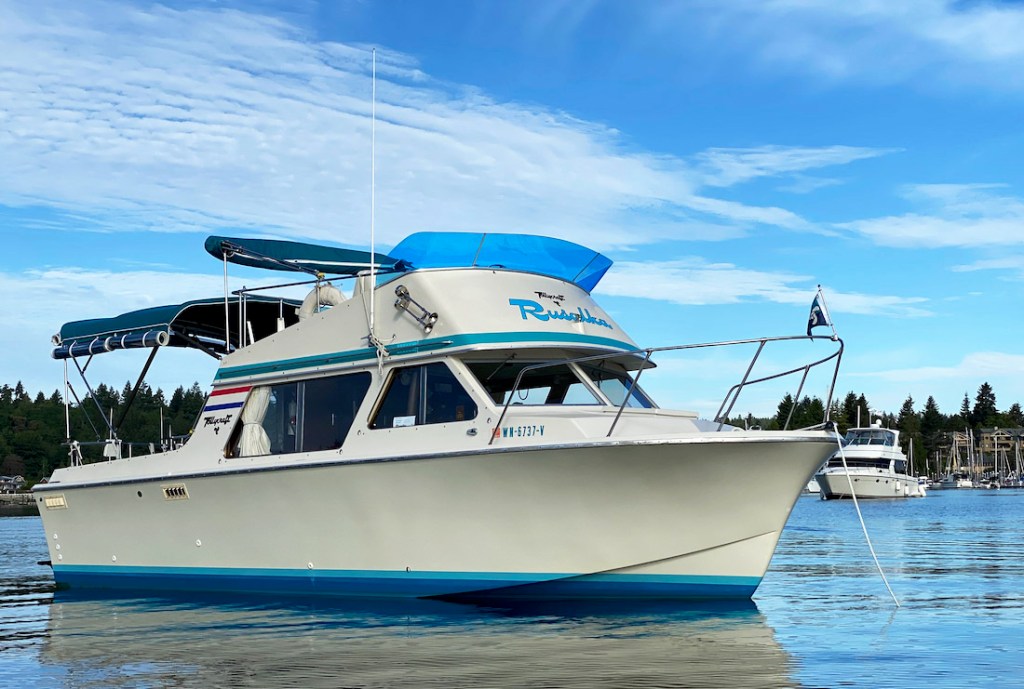
If you have spent any time on the waters of the Pacific Northwest you will have seen many of the Tollycraft boats. There is one however that I think deserves a little special attention…the Tollycraft 26.
I have had several owners of larger Tollys tell me that they started with the Tolly 26 and wish they had stayed with the 26 instead of moving to a bigger boat. That is pretty high (and rare) praise considering most boaters have a constant case of “two-footitis”. Additionally, I have had the opportunity to cruise alongside the m/v Rusalka (a 1974 Tolly 26) for several seasons which has given me a close look at all the Tolly 26 has to offer. Pricing for a new cruiser of similar proportions can quickly pass $200,000.00 so for someone who is wondering if they should get into cruising, the Tolly 26 would be an excellent and economical boat to start with. I have asked m/v Rusalka to summarize Tollycraft’s history and specifically the Tolly 26:
Tollycraft History: Robert Merland (Tolly) Tollefson (1911-2011)
1946 – Tolly purchased a Central Lumberyard and Millwork plant operating it until a raging fire destroyed the plant in 1952. That same year he began Tollycraft Yachts with eight employees. The company soon narrowed the scope of its business activities to boat manufacturing.
1958 – Tollycraft built a plant in the Kelso Industrial Park on 14 acres of land and commenced operations in the new 65,000 square foot building in 1959.
1967 – Tollycraft Yachts began manufacturing fiberglass hulls starting with the conversion of the 24′, 28′, 30′, and 34′ wooden hull designs into fiberglass.
1970 – The last wooden hull boat was built. The very successful 34′ Sedan was the first “keel up” fiberglass design, which sold 194 units in 11 years, and set the Tollycraft design trend for the 1970s.
Source and for more information: https://www.tollyclub.com/about/tolly-tollefson
26 Tolly History and Specs
The 26 sedan as far as I can tell began production in late 1972 as a 1973 model. The end of production is the subject of some debate, but I’ve seen pictures of hull numbers showing builds as late as 1985. Early hulls featured a straight shaft layout, with later production offering v-drive, stern (I/O) drive, and even twin-engine layouts. Total production was near 900 units. Most seem to have left the factory with some flavor of single small block V8 power.
The 26, as with all Tollys of this era, was designed by Ed Monk Sr. and was the company’s most popular model. Construction is of solid fiberglass, stringers are foam filled, which was used only to form the fiberglass. Layout begins with a large 8′ cockpit, step down to the cabin where you’ll find an enclosed head and dinette to port. Along the starboard side is a galley with propane stove, sink, and lower helm. Forward is a large v-berth. Climbing a short ladder from the cockpit is a flybridge with seating for 4 or 5 depending on layout. Early models featured a back-to-back bench seat that folds flat, and a centerline helm. Later models featured two pairs of single back-to-back seats flanking a swiveling helm seat.
These boats remain popular PNW cruisers to this day, the layout is practical and efficient, feeling like a much larger boat than its 26′ length would suggest. Initial build quality was high, and many of these are still found in very good condition, often wearing their still-glossy original gelcoat.
Why we originally bought a 1974 Tolly 26:
As I began to research boats to buy, quality and durability were near the top of the list. Almost every search led me to Tollycraft, they were built right without the corner cutting that plagues so many other production line boats. The stringers get their strength from the thickness of the glass they’re laid up with, the coring is foam and only used to shape them. The hulls are solid hand laid fiberglass and don’t seem to suffer from any of the blistering, hydrolysis, or delamination problems of other builders. As a testament to that, we recently had the bottom of Rusalka sanded to gelcoat in preparation for epoxy barrier coat and new bottom paint. The hull moisture content tested very low, and she’s been in the water continuously since new, 47 years. The fuel tanks can be removed through the lazarette hatch without removing the engine if they need service or replacement. In addition to their reputation for quality construction, we also continually heard what a “big little boat” the 26 Tolly is, and that it handles, rides, and gives most of the amenities you usually find on larger cruising boats in a little 26 foot package. Finally, they seemed at the time, and still do, a great value for money if you can find one with a good engine or that’s been repowered.
After owning and cruising her for four seasons, here’s what we like and dislike.
Likes: Quality, looks, large windows let in lots of light on cloudy NW cruising days. The choice of running from either the flybridge or lower helm, the pride of maintaining and cruising a NW classic – classic boats are just more fun!
Dislikes: Not much that’s the fault of the boat, we’re just getting some “two-footitis” and would mainly like a settee or someplace to lay down and read a book inside other than the dinette or v-berth. Additional interior space when cruising with guests would also be a plus, but the 26 is a perfect couple’s cruiser. The rudder is tiny and the 26s do have a reputation for being difficult to handle at low speeds. Many people have added material to the rudder to help with this. We haven’t found this to be necessary once you get used to the way the boat behaves. Most low speed maneuvering is done with the rudder hard over in one or the other direction and small bursts of power, the prop walk in reverse is quite pronounced as well and can be used to your advantage depending on the situation. And no, we don’t have any thrusters either and won’t be getting any for this boat. For comparison, I had the opportunity to take the m/v Jonta into the marina one day and began furiously spinning the helm as I usually would to make that turn, I just about crashed right into the seawall, it handled like a sports car!
Specifications: Overall Length: 26′ 8″ Beam: 10’0″ OA Height (keel to flybridge): 11′ 0″ Height above waterline: 10′ Draft: 34″ Weight: 9,000 lbs Deadrise: 9 degrees Cruising speed (single v-8): 13 knots Avg fuel consumption (single V-8): 8 GPH Fuel Capacity: 140 gallons (2-70 gallon saddle tanks) Water Capacity: 35 gallons
A couple good articles adding additional info:
https://www.boatingworld.com/boattests/small-boat-big-popularity/
Tollycraft Family, Friends, Boats
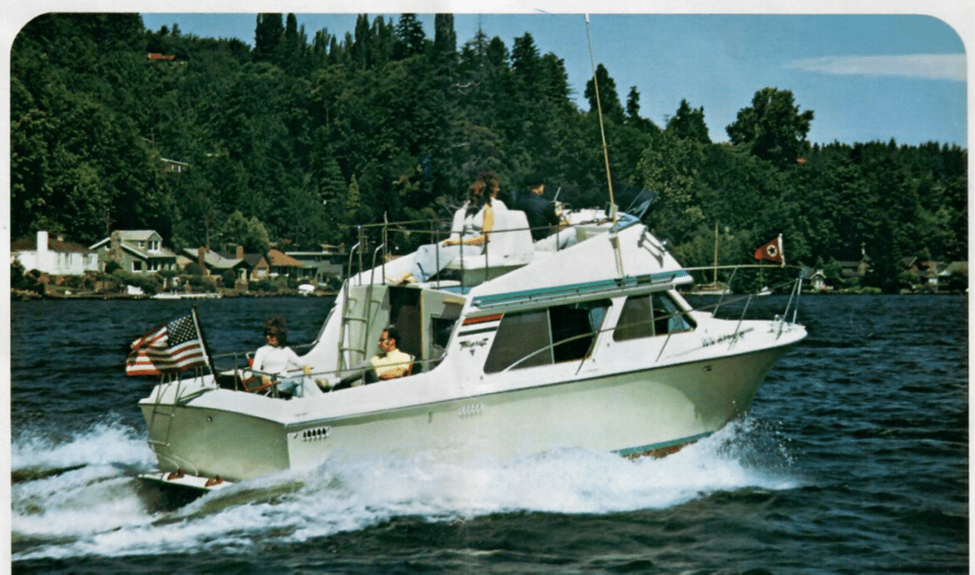
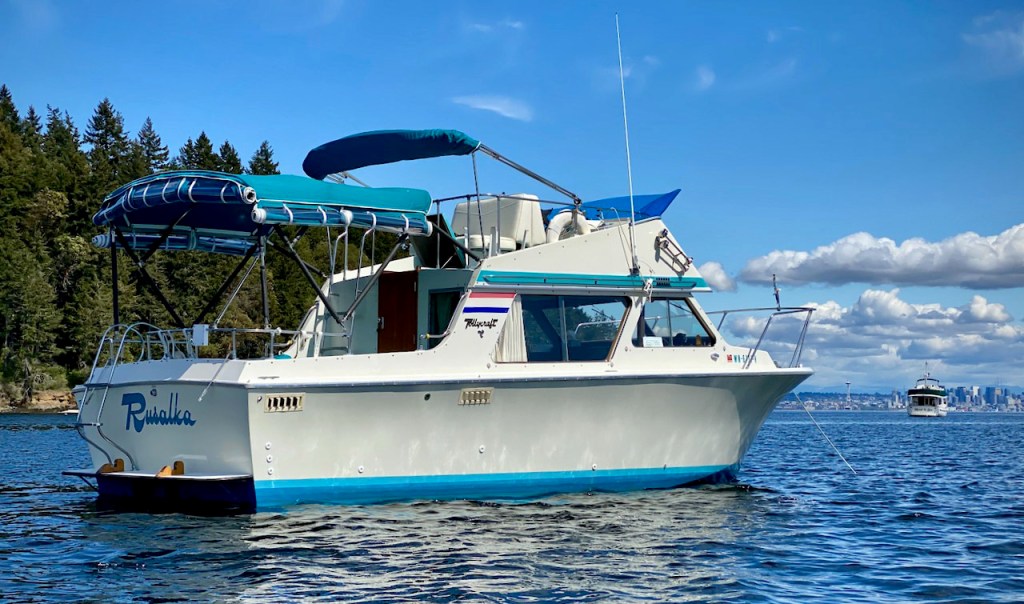
In the two photos below, the upper photo is from a 1974 Tollycraft brochure. The lower (taken by: Akiko Oda, @MVRusalka) Is the 1974 m/v Rusalka summer 2021. I think the m/v Rusalka looks better!
Grandy Boat Company
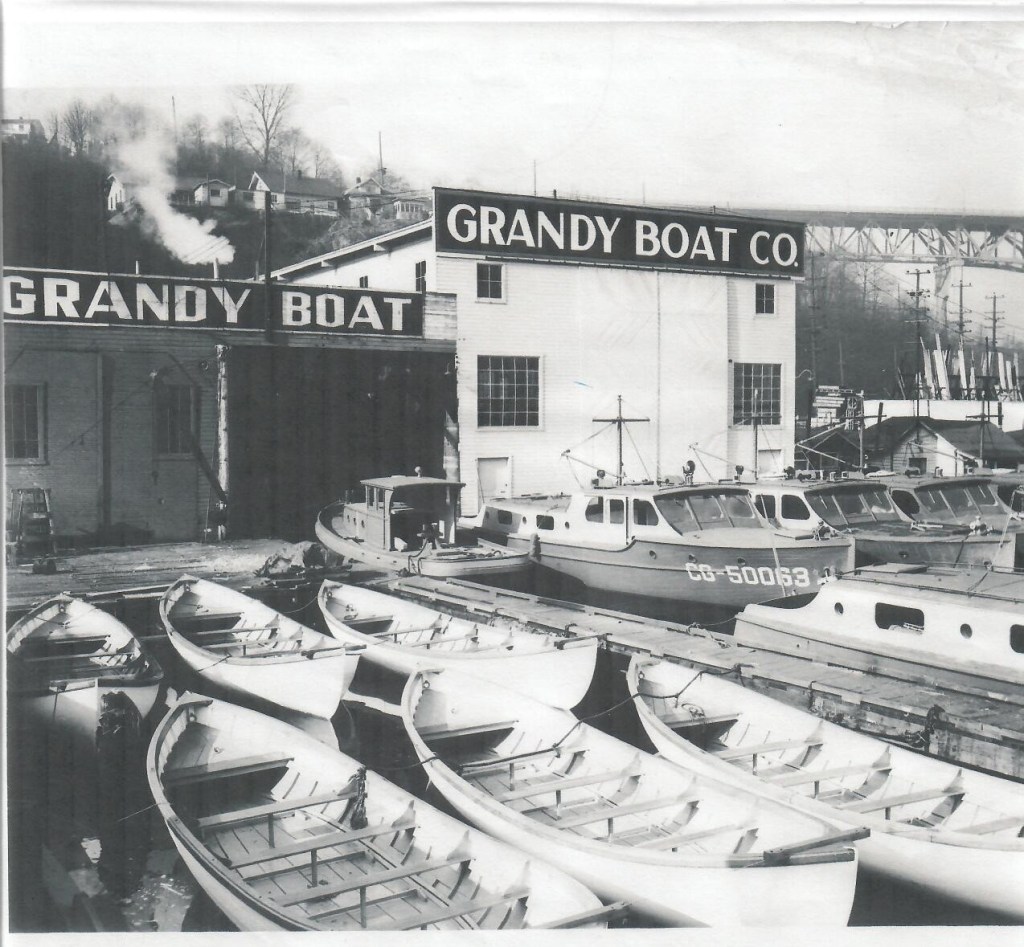
Grandy Boat Company-I was a Grandy owner (see Todd’s Boats Jonta) for many years and early in my ownership I became very interested in the history of the Grandy Boat Company. I teamed up with another Grandy owner and we built a website which covered the history of the company and when we could get it, a brief bio on boats and their owners. Eventually the free webhosting we had went away and the website closed down. However, since creating the content was my task, I still have quite a bit of information, photos etc. The following is from that website.
Grandy Boat Company
“Well-Built Boats” Since 1922″
The tradition of well-built Grandy boats was started by Lewis Lee Grandy in 1903 when he opened the first Grandy boat shop in Tacoma. Lewis started his career as a shipwright working during his teenage years in a shop in Waukegan, Illinois. Lewis came to the Seattle-Tacoma area in 1900 when the boatyard he was working for (Meadheart and Stone) moved to Seattle. The Tacoma shop produced one of the first launches for the Foss Tugboat Co. In 1908, Lewis partnered with Charlie Taylor to establish the Taylor-Grandy yard in Burton on Vashon Island. In 1911 Lewis and Charlie built a raised-deck cruiser to the design of Otis Cutting. This was the inspiration for the Lake Union Dreamboats that where put into production in 1926 by Otis as the owner of the Lake Union Drydock Co. Lewis’ sons Willard (Bill) and Earl learned their boatbuilding skills growing up in the Tacoma and Vashon yards. Soon they were ready to head out on their own.
In 1922, Earl Grandy purchased a floating boat shop and began a boat repair business. He partnered with his brother Bill, and their reputation for quality was soon established. Their formula was simple: “16 hour days of expert craftsmanship”. In less than a year they purchased 350 feet of Lake Union waterfront with a marine haulout railway.
For many years, small skiffs and dories were the bulk of the yard’s business. The 8’ lapstrake model became a favorite lifeboat for the Seattle Parks Department. In the late 1930’s, the larger boat orders started to come in. Ed Monk Sr. had his office in the Grandy yard during that time and many of the boats were of his design. During WWII the Grandy yard turned out many boats under 40’ for the U. S. Navy, which gave them the experience and tooling in the years following the war to step up production. They began to build “Pocket Seiners” for the Alaskan fishermen ranging from 30’-50’.
By the mid-1950’s, Grandy was building in the semi-production “stock cruiser” mode. This differed from boats being built in the 1930’s, which were typically one-offs, started when a customer placed an order. These “stock cruisers” ranged from 27’-32’ and became immensely popular in the Pacific Northwest due to their good looks and comfortable ride. The 27’ model could attain speeds of 30 mph with a single engine. This was reputed to outdo most comparable sized boats built by other local builders.
In 1959, Ted Tate, a California auto dealer, got a taste of the Grandy’s boats and had to have one for himself. Soon, he had established a world-wide dealership for the Grandy-built Malineer Sport Fishing Cruising boats. These ranged in length from 40’-62’ and catered to a more affluent customer. They were typically used for fishing down the Baja coast.
Perhaps one of the best sources to evaluate a yard is to talk to the people who worked there, who knew what went into the boats, and how they were built. It has been said that the Grandy Boat Co was the best woodenboat builder on the lake with the Blanchard yard a close second. Nothing but the best materials went into the boats. All materials where inspected by Earl and he was know to reject an entire truckload if he did not like what he saw. One shipwright remembers a luckless coworker that did not cull out a piece of wood that was not up to par and put it in a boat. Bill Grandy was in charge of production and apparently he was not afraid to project his opinion of the workers abilities across the yard.
On August 25th , 1967, the Grandy yard burned, ending the tradition of “well-built boats” that had spanned two generations as well as many significant changes in the design and use of recreational boats. Bill continued on for a time as a supervisor at another boatbuilding firm. Earl passed on in January of 1982 to be followed 7 years later by Bill in July of 1989.
The majority of this information comes from Steve Bunnell’s article, “The Grandy Boat Company” and Bet Oliver’s book Ed Monk and the Tradition of Classic Boats.
 Todd Powell Boats