We discussed in a past blog (February 21, 2024) that it can be helpful to decide on how long you may want to own a boat. Regardless of which timeframe you decided on, you need to care for the boat like you are going to own it forever and pass it down to someone you don’t hate.
A boat is a consumable product just like cars and homes. Its various parts will wear out over time, luckily at different rates, but wear out they will. If you decided you were going to keep the boat for 5 years and figured you could push some of those maintenance items to the next owner, you will find your boat will be more difficult to sell. A boat with a long list of deferred maintenance items does not typically show or survey well. If we keep the mindset of longtime ownership, we know that we (not the next person) will have to deal with deferred maintenance eventually and that should push us to keep to proper maintenance intervals. This also will help to avoid a big headache in the middle of August when we want to be on the water. For those that subscribe to the “I will fix it when it breaks” mindset, I suggest you keep your towboat insurance up to date.
By sticking with good maintenance practices, when that day does come to sell, you will have set yourself up for the best chance of a quick sale at a decent price. And hopefully your years of boating, regardless of the number, will have been as hassle free and enjoyable as possible.
I get it-pulling the trigger on a boat purchase is hard to do. It is a big commitment of time, money, and your effort (see Feb blog). You are looking for that perfect boat, that fits all of your needs 100% of the time-unfortunately, that boat does not exist. We must live with some trade-offs or dare we say “imperfections” (hushed tones of course!).
I suggest looking for the boat that will fulfill 90% of your needs, especially if that final 10% will only be used occasionally. Looking for a boat with large guest stateroom and two heads? Why? Because you invite guests on your boat for two or three weekends a year? I hope they will be grateful for the extra expense you incurred, but probably not.
Does your ideal boat even exist? That heavy deep-keel trawler you want to move at higher speeds with low fuel burn. We are all still looking for that one.
It may be that you want to add moorage into the mix. Now you are looking for the perfect moorage, to be available at the exact same time as the perfect boat, at the perfect price. You must start somewhere, if the moorage becomes available where you want, try to grab it. If it is the boat that arrives first, buy it and work through the moorage over time.
There are many trade-offs, big and small, you will need to make if you want to be able to find a boat and situation that works for you. Waiting for the planets to align perfectly is just a way to avoid beginning. Find the 90-percenter and take that first step. Imperfect looks pretty good when you are tooling down the bay on a sunny day.
As a yacht broker, 99.9% of the time I receive a call it is about a specific boat. Rarely am I asked about my qualifications to help someone purchase a boat. Most people fall under what I call the “car-lot” purchasing model. You see the car on the internet, you go to the lot, find the nearest helpful person and you purchase. Cars are expensive, but boats can be very expensive and are much more complicated in both the purchasing process and in operation. If you are an experienced boat owner the car lot program may work for you. But I have found that even experienced boaters may not have kept up with some of the changes in the boating industry and are suddenly caught by surprise and must modify their plans. Regardless, if you are just getting into boating or stepping up or down in boat size, then a little help is a good thing.
I recommend you take the time to find a broker who is willing to help you decide what is the best boat to meet your goals, both financially and experientially. A broker can get information on any listing and can help you purchase a boat regardless of the brokerage that has it listed. (A quick side note here, if you are purchasing a new boat you need to deal directly with the boat builder’s dealer in your area.)
How to find a good broker? A referral is always an excellent place to start if you have boating friends or acquaintances who have recently purchased a boat. Or spend a little time looking at brokerage websites and see if any feel like a good “fit” for you. Some brokers focus on different areas, and you may find one that matches your interests. Finally, when you do decide to pick up the phone and call, even if it is about a specific boat, have a few questions ready for the broker. Here are a few to start with.
What is your experience?
Do you have a particular interest or focus?
How would you walk us through the process of selecting a boat?
Do you have any references from past clients?
Do you have time to take on another client?
Spend as much time as you like browsing the internet looking at boats, but when it comes time to move forward and begin a serious search that will result in your new boat-find a broker to help you. If this feels like an added complication, take a moment to think about all the experts you rely on and ask why this should be any different?
Most of us have an idealistic vision of boating. Mine is sitting on the back deck watching the sun come up with a cup of strong black coffee-nothing better. Your vision might be similar or completely different but still, that is what drives you to overcome what we might refer to as the “inconveniences” of boat ownership. Boating is not for the faint of heart! It takes effort: the maintenance, the loading and unloading of food and equipment. How about the end of the day wash down late at night when you really just want to get to bed. Heaven forbid if you keep your boat on a trailer and have to not only launch the boat but somehow get it back!?! Then there is what I refer to as “fun-suffering”. The tasks that start out fun and end…less fun. I love to varnish, but by the time I get the last coat on each season-I am suffering, or at least my back is. And we haven’t even gotten to the cost. The annual trip to the boat yard where they hand you an estimate that everyone knows might be 25% of the final bill. Then there is insurance which you MUST have but you cannot USE because then you will be CANCELLED. All said with a smile😊 by your insurance provider. So it all begs the question-why? Why would we voluntarily put ourselves through the hassle, the inconvenience, the expense of owning a boat? Those 30-45 mornings a year when I get to watch the sun come up with that cup of excellent coffee is my answer and I am happy to pay the price.
In our January blog, we discussed that making a large purchase, such as a boat, is primarily an emotional decision. But now that you have made that decision, you need to move on to the less fun, mundane things. The question of how long you intend to own a boat is a great next step.
Buying a boat is a big deal, it is a fun deal, but still big. It takes time, effort, and money, which are the three most valuable things we have available for us to “spend”.
It follows that you should at least have an idea how long you want “spend” these resources on boating. If you are looking for a lifestyle for as long as you can crawl around the deck (that is me) then you can spread the costs of your effort and money across more time. If you are looking for a short-term specific experience like completing the Great Loop or a run up the Inside Passage, then those costs will be incurred in a shorter time frame. This will not only define the type of boat you might want to buy, but brings into the discussion things like depreciation, sales tax, broker’s fees, title fees, lending fees, interest rates, sales costs etc. A boat is typically a depreciating asset and the chance to recoup any costs through appreciation is slim. Each one of these items is worthy of discussion and needs to be understood as you move through the process. If you are new to boating, I recommend you find and work with an experienced broker that can help you evaluate these questions and what works best for you. Part of the boating journey is selling your boat and decisions made at the beginning can make all the difference how you feel about the finish. Which brings us back to the initial question of how long? Are you going to spread the use of those resources over 5, 10 or more years? Give it some serious thought and it will help guide you towards the right boat for you.
Buying decisions are emotional decisions – full stop. We think we are making a cold, logical calculation, but that is only after we have already made an emotional decision and need to back it up with facts. Without facts, we risk our friends and family thinking we are crazy. I am not referring to the types of buying decisions where you are choosing between two things that give you the same result, like laundry soap. In that case you have already made the emotional decision that you like wearing clean clothes. I am talking about the bigger purchases, the ones that are large enough to make you hesitate: jewelry, houses, cars, and of course, boats. Understanding and accepting that emotions make the decisions on what you buy is freeing. When your uncle asks you why bought the candy-apple-red-two-door-roadster while you have three kids under 6; “because it’s fun!” is an honest answer. I own boats because they give me access to a lifestyle that makes me feel good. It opens the door to friendships and experiences that I enjoy. Owning a boat makes no sense from a cold, analytical financial perspective… and I don’t care. Whatever your buying decision is, realize that logic is not truly part of the decision, only the justification.
I am not suggesting that you run out and make financially destructive purchases. However, if you can afford the purchase, quit worrying about it making sense, because it probably does not.
Many of us have an irresistible (or irresponsible) attraction to older things. Especially older things that whirr, clank and clunk. It might be a car, a Hi-Fi System (you youngsters can look that one up) a motorcycle, a house etc. I prefer boats, specifically, powerboats. I had some time to think about this lately when I was hanging upside down in the bilge removing 50 year old valves and thruhulls. Was it all the blood rushing to my head as I used every ounce of meager leverage I could muster on a two foot pipe wrench sandwiched between a bulkhead and frame that caused me to question myself? Why the attraction? I could have been at home binging Netflix! I am fascinated by the “why” behind every action we take and there is nothing like hanging upside down in the bilge to start you wondering about your “why”.
Provides a sense of control over some aspects of your life
So much of what we use today is either highly complex or intended to be tossed in the bin at the end of its useful life. Your smart phone for example, is highly complicated and for most people the extent of our ability to repair it is turning it off and then back on. If that doesn’t work, you’re doomed! This is a tradeoff I am willing to make so that I can have a smart phone. But if everything in my life were like that, it would lead towards a feeling of powerlessness and frustration. When I have some ability to repair the thing, then I feel a bit better. It’s that sense of control in your life that we seek.
Provides opportunity for a self-esteem boost:
C.G. Jung says, “Where your fear is, there is your task.” Normally we think of fears as big-ticket items such a fear of flying or public speaking. But we have many little fears as well and I have learned to use this quote to direct me in all aspects of life, even my boat stuff. As soon as I think, “I don’t know if I can do that” I figure I had better plan on getting to it. It isn’t always pretty, and frequently painful but when it’s done, it creates a sense of accomplishment I can feel good about. This challenge and the process of overcoming will improve how you feel about yourself.
Provides a chance for a bit of uniqueness
Much of our lives conforms and matches to the larger norms that surround us. Dipping a toe in to the old stuff gives us the chance to feel like we are at least a little bit different from the rest of the world. Being one of the few who can repair or rebuild something old puts you in a rare category. A category that is getting rarer as time passes.
Provides challenge-because it is there
Sometimes it’s merely the challenge that moves us to pick up a tool and see what we can accomplish. There can be a physical challenge of performing the work, or there can be a mental challenge of researching solutions to a problem before you start. Internet searches and phone calls, acquaintances and friends are all part of the network we use to figure out a direction. How about the emotional/temperament control needed when your fixing also involves others? Coordinating vendors and suppliers in today’s environment can be a bit frustrating at times. All of these challenges can provide a sense of accomplishment.
Provides Continuing Education
One of the benefits to being an adult is you get to choose how and what to learn. Much of our learning is absorbing new information either through video (think youtube) or reading. I’m a tactile learner. I read a lot, but the amount of knowledge I get from all my reading is far less than the amount of knowledge I will get from working with my hands on something. Much of the old stuff provides this opportunity without requiring a bunch of specialized knowledge before you start, and the rest you can learn as you go.
Provides a chance to blend the old with the new
Much of the new technology, while it can be great, is thrust upon us regardless if we want it or not. We have all experienced being forced to buy a “new and improved” item because the old one is no longer supported. For example, it is hard to find a basic phone these days. Most of us wander around with the computing power of the Starship Enterprise in our pocket. Some of the modern technology is amazing and useful, so I tend to blend it a bit. My boat may be 50 years old and built of wood, but I do have the latest in Garmin electronics. Just as I am sure your 1920’s craftsman bungalow has WiFi.
Give it some thought, perhaps your future…is something from the past.
I don’t know about you, but I find mid-winter a pretty tough time to stay motivated. This is especially true for the outside projects that responsibilities, weather and lack of light have stretched out into a seemingly never-ending drudgery. I have one of those going right now: a leak at the base of the salon door track that was showing up on top of the water tank in the lazarette. As most projects go on old boats, I was soon removing teak decking, sub-decking, the salon door and track. Then the hinderances and obstacles crept in. Here in the PNW we have about 8 hours of light during the darkest part of the year and even some of those days are pretty dark with low cloud cover and rain. So, if you need daylight, it is very limiting. Then there are the freezing temperatures and yes, this year, even a week of snow. Well, none of your adhesives are going to do much under those conditions. “The Holidays”!? Who invented the holidays? That is just a reason for family to fly in and visit. How then are you supposed to get anything done? What about work? Well, you need some money to pay for this floating beast that is just staring at you waiting for you to fix the gaping hole in the back deck. How about those home projects you promised you would get to this winter? At least most of those are inside and can be done during the darker hours so you make progress and pretend that you care. Then that niggling, creeping sense of dread starts-what if you are not done in time for the cruising season? That would be an epic fail! That is motivation for sure, so I think I will load up my tools and head down to the boat. One way or another, “the end is nigh” or the end is near.
In Part One, I discussed how we narrowed down the key criteria to help select which boat to buy. Once that was completed, we started analyzing which boats might fulfill those criteria. In our case, we also had the “unspoken” criteria of wood. I have always had wood boats and you can go to my “Why Wood” blog for that discussion. Once we had decided the Grand Banks 32 would fit all our criteria, we then put a time frame to having our purchase completed. If you have a 10-year horizon, you can always keep looking. Looking for the “perfect boat”, which does not exist; our horizon was more in the one-year range, so we had to work with what was on the market right then. The GB32 is a popular model and there are typically only a few on the market at any given time. For example, today on Yachtworld, there is one within driving distance and a total of six on the West Coast. When we were searching, there were about 7 on the market in our area, of which we decided to look at three, and ultimately chose THE ONE.
Buying any boat over 15 years old, wood or otherwise, means you will have to spend some time and/or money on repairs and what I like to call “major maintenance”. You may also want to install some upgrades that are more to your liking. The older the boat, the closer you want to look at the systems. They wear out over time, and you may find you are replacing more than you anticipated in your first years of ownership. Additionally, you will need to decide if you are going to attempt some of this work yourself or pay to have all, or some of it done and factor that into your calculations. I enjoy all of the projects and will attempt most things except for major engine repair. However, in the variety of projects a boat provides, I do enjoy the woodwork, paint, and varnish more than the systems. We were also not looking for a total project boat, but one that could be used during the summers and worked on during the winter.
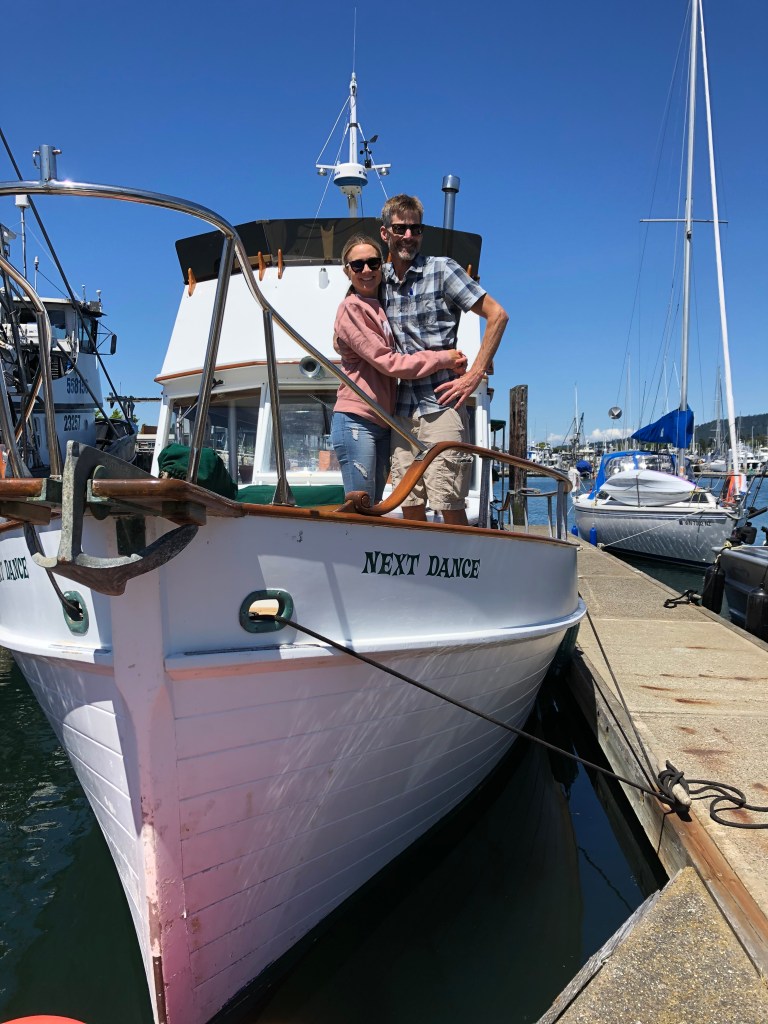
To recap, we first had the criteria to figure out which model of boat and second, we had our final criteria to select between boats of that model. Our final criteria were: wood, in useable condition at point of purchase, potential projects more toward the wood/paint type instead of systems, and some system upgrades. What we finally found at the Grand Yachts Brokerage in Sidney BC was a 1972 (right at the end of the wooden GB era) that had some system upgrades, but that would require some work over time. Here is a brief description of the upgrades already completed:
The plumbing system had been replaced with “pex” and the Whale “quick connect” fittings and pump.
The electrical system now included six 6-volt batteries with a charger/inverter and Heart monitor. We have yet to truly test the depth of this capacity. Even three days on the hook running the 12v refrigerator and other standard electrical use barely makes a dent. The 110V upgrade included a Blue Seas breaker panel to take the added load of the inverter, hot water tank and outlets.
The propane stove had been removed and replaced with a Dickinson stove with a second hot water tank mounted in the flybridge cabinet. The tank is heated by a closed loop from the stove to the tank. The advantage to this is that when at anchor, you usually only get about a day from your regular hot water tank which is heated up by running the engine. With the Dickinson running, you will have hot water the rest of the time. The downside to the Dickinson is during the hot days of the summer you cannot use the stove for cooking as it will run you out of the cabin. Instead, we use a single burner camp stove and the BBQ. I will confess we were uncertain if we would keep the Dickinson as we had been cooking with a propane stove and oven the last 18 years. But after two seasons with this setup, we like it. The stove provides plenty of dry heat on the cold, wet days and it allows us to hang on the hook with plenty of hot water. The Dickinson requires a little getting used to, but I think I have figured out its idiosyncrasies.
Holding tank system had been installed with Tankwatch and overboard pump when in the area it is legal to pump overboard.
The fuel tanks had been replaced
Newer 12V refrigerator
The original headliner had been removed and a new installed on removable panels. This allows for quick access if you need to run any wiring.
The original windlass has been replaced with a Simpson Lawrence 600 series,
The boat had a full complement of canvas including over the back deck which has provided much needed shade on our few hot days here in the PNW.
What were some of the immediate needs?
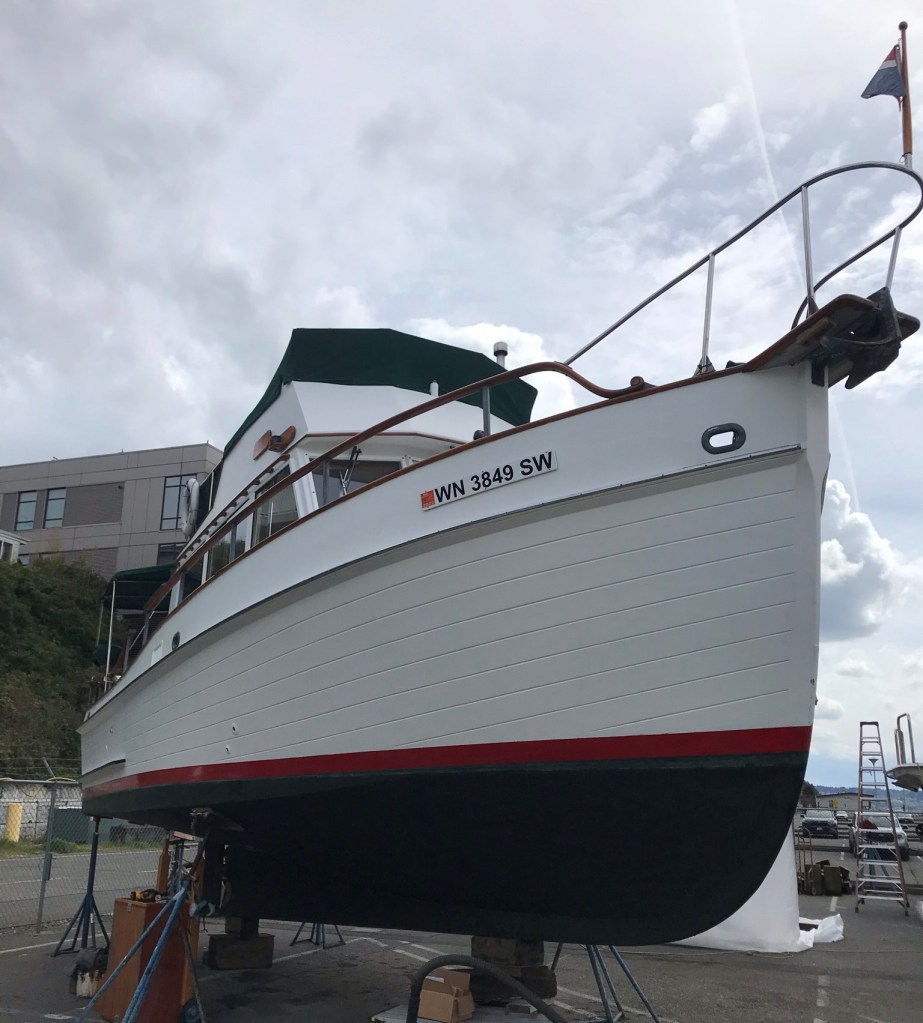
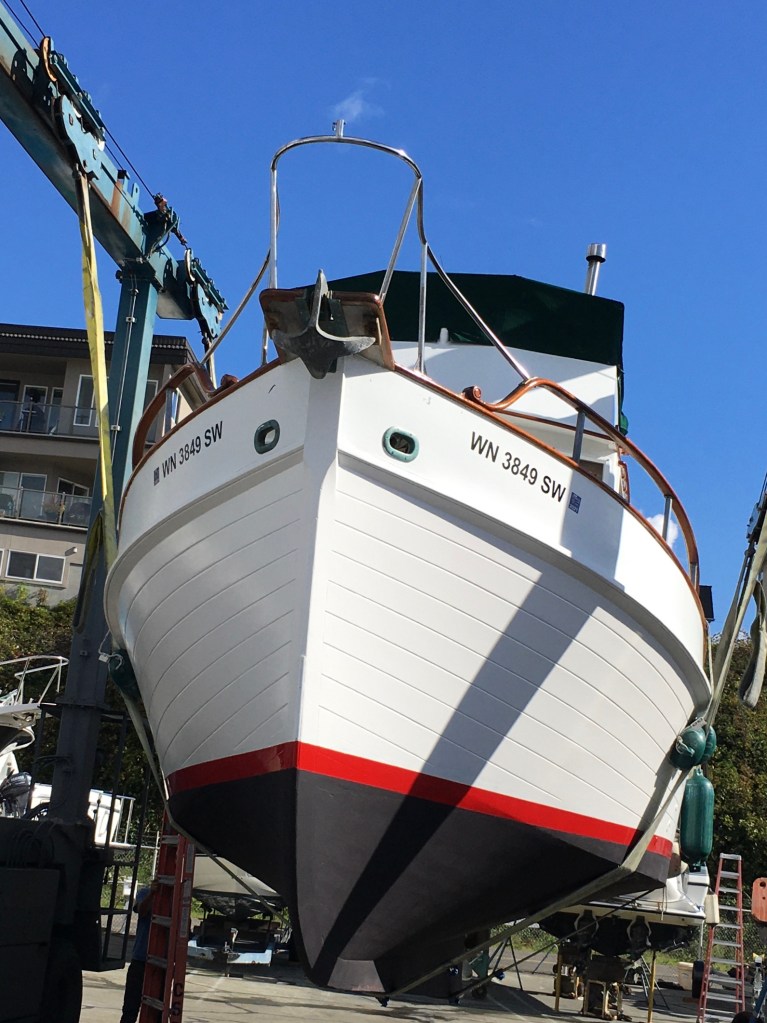
All the paint was very tired, especially the hull and bootstripe.
The electronics were ancient, though functional
Lots and lots of bilge and motor cleaning.
The injector pump was leaking and needing a rebuild
The ElectroGaurd system was nonfunctional
This was the starting list at purchase. Since then, as we have gotten to know the boat, our list has grown. Some items are necessary and some just preference, but I spent 18 years on the last one, so I’ve got time….
To wrap up, your criteria will be different than ours, but unless you distill it down to the top few, you will never be able to come to a decision or you will make a poor one. That being said, you can almost always recover from a purchase that did not work out. I am always more in favor of forward motion than standing still. So, pick your criteria and get boating…
People are attracted to all sorts of boats for all sorts of reasons. When making a decision about which boat to buy, it is necessary to distill it down to a few key criteria. The criteria are different for everyone but if you can’t whittle it down, you will probably never buy a boat, or you will find out you have bought the wrong boat which can be a major hassle and expense. I thought I would share with you our process which led us to our current boat. Part One will cover how we selected the style and layout that ultimately our Grand Banks 32 fulfilled, and Part Two will cover how we decided on a specific boat within the GB32’s available at the time.
After boating for many years on a variety of boats, we’ve worked through some of the big picture questions. Did we want a power boat or sailboat? We wanted power. Did we want to day trip or stay onboard for several days and nights at a time? We prefer to stay aboard. Are we going to be on the open ocean or inland? Our cruising area is the Inside Passage which stretches from Olympia, WA to Ketchikan AK. There are some large bodies of water to contend with depending on your destination, but for the most part it is protected and by watching the weather you can cruise comfortably.
Now we move on to some of the harder questions and the first one most start with is-how big? I believe length is a bit of proxy for volume, but length gets your started. You will need to moor it somewhere and length can be a major constraint. Based on our experience, 36 feet in overall length seemed like the right upper limit for us. Small enough to tuck into some of our favorite smaller anchorages yet big enough to handle some of the larger bodies of water (always watching the weather of course!) we travel on. For us, added length and volume beyond 36 feet is not necessarily added benefit. Additionally, it can’t be larger than you are comfortable handling and as I do solo frequently, I was not sure I wanted to handle much more boat by myself. Especially a boat with a single screw and not a thruster to be seen! Our GB32 has a length overall of 36.5 feet.
Speed and mass is another early question to ask. After years of cruising along in a semi-planing hull at 13 knots we knew we wanted the weight and seakeeping ability of a displacement hull. The big trade-off is speed with the add-back of much lower fuel consumption. We went from a 7500 pound boat at 13 knots to an 18,000 pound boat at 7 knots. This gives a lot more stability when the waves kick up and so far this is much more relaxing. It’s possible to have both speed and mass, which is a semi-displacement hull, but you will need to plan your fuel stops accordingly!
Designated spaces brings us back to the volume discussion. The beam (width) and the depth of the boat starts to impact spaces and how you use them. Many boats have spaces that have more than one use, such as a dinette that converts into a berth or a salon that is also the sleeping quarters. This can be fine assuming the persons aboard will not need the same space at the same time for different uses. We wanted to keep this conflict to a minimum, so we had to decide on what activities were critical to us. We were looking for the following designated areas: helm station, head/shower compartment, sleeping quarters, galley, interior lounging and exterior lounging. We wanted all of these to be separate areas. With a length limit of 36 feet, we would need a wider, deeper boat. The GB32 met these requirements. We also like to live on one level as much as possible which the GB32 does well. The aft deck, main salon, galley and helm are on one level. The stateroom is three steps down forward and the flybridge (major sun zone) is up a ladder. More importantly, the stateroom closes off so that my early morning coffee making doesn’t disturb the late sleeper.
Every trip starts and ends with moving around the boat to set fenders, handle mooring lines or anchoring. Having spent time on other boats with wide walk-around decks behind bulwarks and rails, we realized how much easier this made the handling of lines, fenders and anchor. The GB32 has a low bulwark with a rail extending above. The decks are wide with only one step at the back of the cabin to the rear deck. You give up a bit of room in the cabin, but it beats clinging to the side of the boat with toes and fingers while the boat rolls. We find the trade-off worthwhile. The question of single engine vs. twin engine vs. thrusters vs. joystick control is worthy of its own dissertation but at the end of the day if you don’t think you can get it in and out of the dock, you won’t use the boat. You will need a system of controls that gives you that confidence. I am comfortable with a single screw, but that doesn’t mean it hasn’t been exciting on occasion!
Size, speed and mass, designated spaces, ease of handling-these were the “key criteria” we used to narrow our search. Yours might be similar or completely different but you will need to get it to just a few. No boat will be able to meet twenty key criteria but there are plenty of boats that can meet four, five or six. Once we started applying our key criteria, the list of possibilities shrunk dramatically. In Part Two we will finish up our discussion of how we ended up with an older, wooden Grand Banks 32.

 Todd Powell Boats