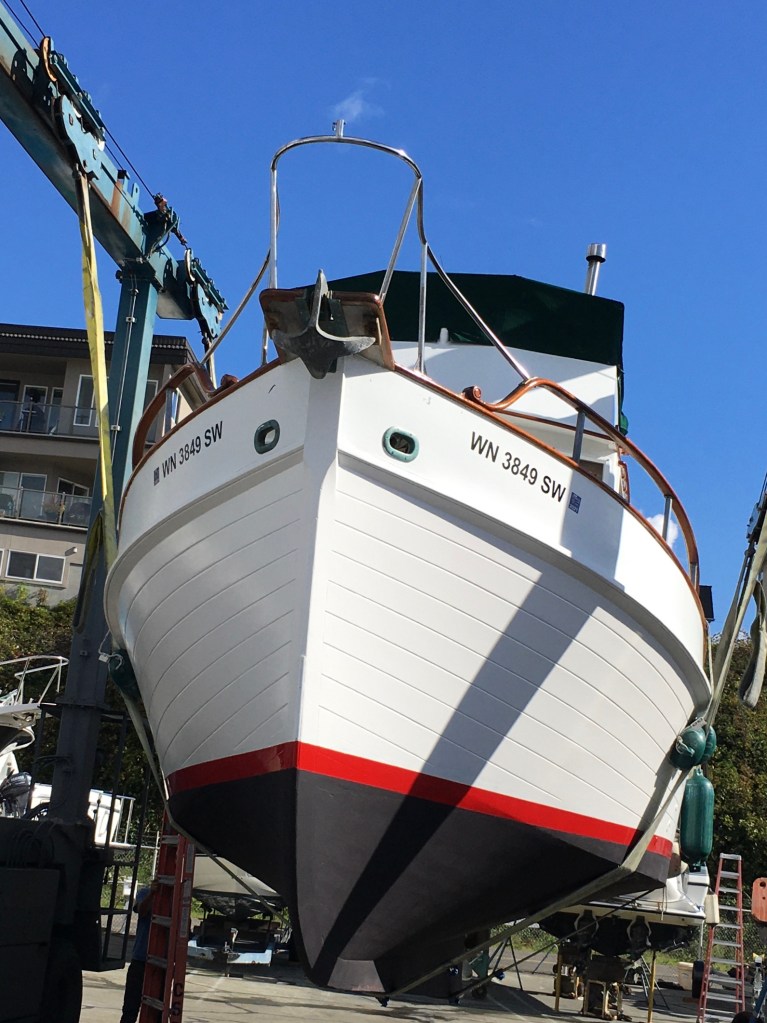
In Part One, I discussed how we narrowed down the key criteria to help select which boat to buy. Once that was completed, we started analyzing which boats might fulfill those criteria. In our case, we also had the “unspoken” criteria of wood. I have always had wood boats and you can go to my “Why Wood” blog for that discussion. Once we had decided the Grand Banks 32 would fit all our criteria, we then put a time frame to having our purchase completed. If you have a 10-year horizon, you can always keep looking. Looking for the “perfect boat”, which does not exist; our horizon was more in the one-year range, so we had to work with what was on the market right then. The GB32 is a popular model and there are typically only a few on the market at any given time. For example, today on Yachtworld, there is one within driving distance and a total of six on the West Coast. When we were searching, there were about 7 on the market in our area, of which we decided to look at three, and ultimately chose THE ONE.
Buying any boat over 15 years old, wood or otherwise, means you will have to spend some time and/or money on repairs and what I like to call “major maintenance”. You may also want to install some upgrades that are more to your liking. The older the boat, the closer you want to look at the systems. They wear out over time, and you may find you are replacing more than you anticipated in your first years of ownership. Additionally, you will need to decide if you are going to attempt some of this work yourself or pay to have all, or some of it done and factor that into your calculations. I enjoy all of the projects and will attempt most things except for major engine repair. However, in the variety of projects a boat provides, I do enjoy the woodwork, paint, and varnish more than the systems. We were also not looking for a total project boat, but one that could be used during the summers and worked on during the winter.
To recap, we first had the criteria to figure out which model of boat and second, we had our final criteria to select between boats of that model. Our final criteria were: wood, in useable condition at point of purchase, potential projects more toward the wood/paint type instead of systems, and some system upgrades. What we finally found at the Grand Yachts Brokerage in Sidney BC was a 1972 (right at the end of the wooden GB era) that had some system upgrades, but that would require some work over time. Here is a brief description of the upgrades already completed:
- The plumbing system had been replaced with “pex” and the Whale “quick connect” fittings and pump.
- The electrical system now included six 6-volt batteries with a charger/inverter and Heart monitor. We have yet to truly test the depth of this capacity. Even three days on the hook running the 12v refrigerator and other standard electrical use barely makes a dent. The 110V upgrade included a Blue Seas breaker panel to take the added load of the inverter, hot water tank and outlets.
- The propane stove had been removed and replaced with a Dickinson stove with a second hot water tank mounted in the flybridge cabinet. The tank is heated by a closed loop from the stove to the tank. The advantage to this is that when at anchor, you usually only get about a day from your regular hot water tank which is heated up by running the engine. With the Dickinson running, you will have hot water the rest of the time. The downside to the Dickinson is during the hot days of the summer you cannot use the stove for cooking as it will run you out of the cabin. Instead, we use a single burner camp stove and the BBQ. I will confess we were uncertain if we would keep the Dickinson as we had been cooking with a propane stove and oven the last 18 years. But after two seasons with this setup, we like it. The stove provides plenty of dry heat on the cold, wet days and it allows us to hang on the hook with plenty of hot water. The Dickinson requires a little getting used to, but I think I have figured out its idiosyncrasies.
- Holding tank system had been installed with Tankwatch and overboard pump when in the area it is legal to pump overboard.
- The fuel tanks had been replaced
- Newer 12V refrigerator
- The original headliner had been removed and a new installed on removable panels. This allows for quick access if you need to run any wiring.
- The original windlass has been replaced with a Simpson Lawrence 600 series,
- The boat had a full complement of canvas including over the back deck which has provided much needed shade on our few hot days here in the PNW.
What were some of the immediate needs?
- All the paint was very tired, especially the hull and bootstripe.
- The electronics were ancient, though functional
- Lots and lots of bilge and motor cleaning.
- The injector pump was leaking and needing a rebuild
- The ElectroGaurd system was nonfunctional
This was the starting list at purchase. Since then, as we have gotten to know the boat, our list has grown. Some items are necessary and some just preference, but I spent 18 years on the last one, so I’ve got time….
To wrap up, your criteria will be different than ours, but unless you distill it down to the top few, you will never be able to come to a decision or you will make a poor one. That being said, you can almost always recover from a purchase that did not work out. I am always more in favor of forward motion than standing still. So, pick your criteria and get boating…
 Todd Powell Boats