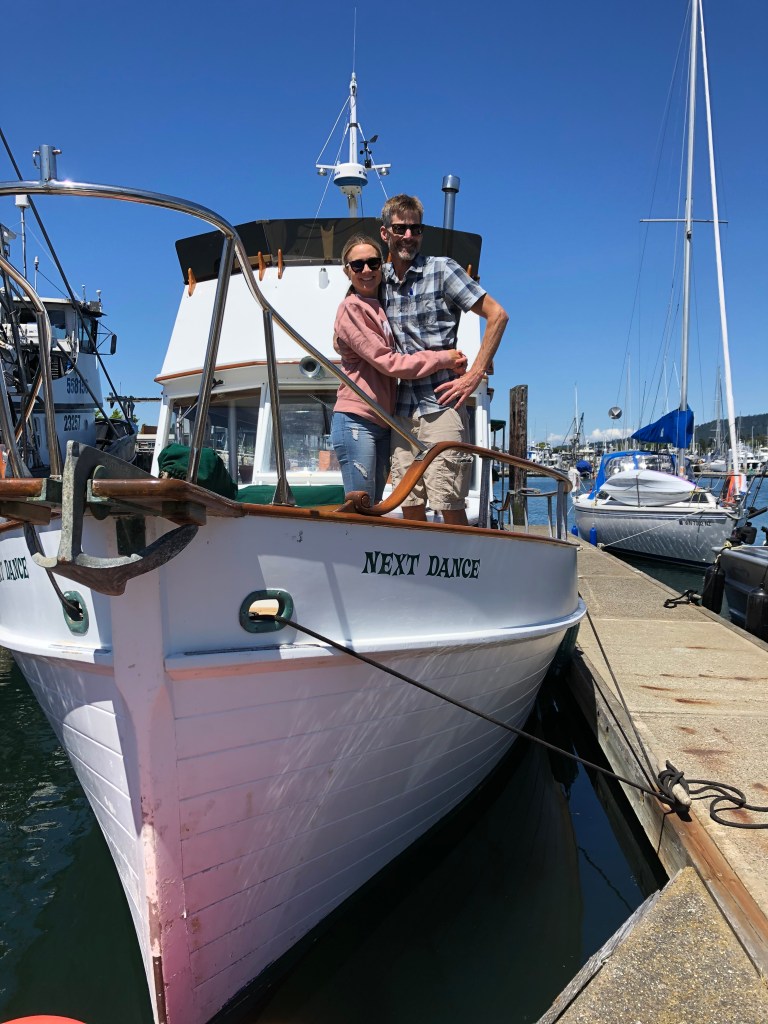
People are attracted to all sorts of boats for all sorts of reasons. When making a decision about which boat to buy, it is necessary to distill it down to a few key criteria. The criteria are different for everyone but if you can’t whittle it down, you will probably never buy a boat, or you will find out you have bought the wrong boat which can be a major hassle and expense. I thought I would share with you our process which led us to our current boat. Part One will cover how we selected the style and layout that ultimately our Grand Banks 32 fulfilled, and Part Two will cover how we decided on a specific boat within the GB32’s available at the time.
After boating for many years on a variety of boats, we’ve worked through some of the big picture questions. Did we want a power boat or sailboat? We wanted power. Did we want to day trip or stay onboard for several days and nights at a time? We prefer to stay aboard. Are we going to be on the open ocean or inland? Our cruising area is the Inside Passage which stretches from Olympia, WA to Ketchikan AK. There are some large bodies of water to contend with depending on your destination, but for the most part it is protected and by watching the weather you can cruise comfortably.
Now we move on to some of the harder questions and the first one most start with is-how big? I believe length is a bit of proxy for volume, but length gets your started. You will need to moor it somewhere and length can be a major constraint. Based on our experience, 36 feet in overall length seemed like the right upper limit for us. Small enough to tuck into some of our favorite smaller anchorages yet big enough to handle some of the larger bodies of water (always watching the weather of course!) we travel on. For us, added length and volume beyond 36 feet is not necessarily added benefit. Additionally, it can’t be larger than you are comfortable handling and as I do solo frequently, I was not sure I wanted to handle much more boat by myself. Especially a boat with a single screw and not a thruster to be seen! Our GB32 has a length overall of 36.5 feet.
Speed and mass is another early question to ask. After years of cruising along in a semi-planing hull at 13 knots we knew we wanted the weight and seakeeping ability of a displacement hull. The big trade-off is speed with the add-back of much lower fuel consumption. We went from a 7500 pound boat at 13 knots to an 18,000 pound boat at 7 knots. This gives a lot more stability when the waves kick up and so far this is much more relaxing. It’s possible to have both speed and mass, which is a semi-displacement hull, but you will need to plan your fuel stops accordingly!
Designated spaces brings us back to the volume discussion. The beam (width) and the depth of the boat starts to impact spaces and how you use them. Many boats have spaces that have more than one use, such as a dinette that converts into a berth or a salon that is also the sleeping quarters. This can be fine assuming the persons aboard will not need the same space at the same time for different uses. We wanted to keep this conflict to a minimum, so we had to decide on what activities were critical to us. We were looking for the following designated areas: helm station, head/shower compartment, sleeping quarters, galley, interior lounging and exterior lounging. We wanted all of these to be separate areas. With a length limit of 36 feet, we would need a wider, deeper boat. The GB32 met these requirements. We also like to live on one level as much as possible which the GB32 does well. The aft deck, main salon, galley and helm are on one level. The stateroom is three steps down forward and the flybridge (major sun zone) is up a ladder. More importantly, the stateroom closes off so that my early morning coffee making doesn’t disturb the late sleeper.
Every trip starts and ends with moving around the boat to set fenders, handle mooring lines or anchoring. Having spent time on other boats with wide walk-around decks behind bulwarks and rails, we realized how much easier this made the handling of lines, fenders and anchor. The GB32 has a low bulwark with a rail extending above. The decks are wide with only one step at the back of the cabin to the rear deck. You give up a bit of room in the cabin, but it beats clinging to the side of the boat with toes and fingers while the boat rolls. We find the trade-off worthwhile. The question of single engine vs. twin engine vs. thrusters vs. joystick control is worthy of its own dissertation but at the end of the day if you don’t think you can get it in and out of the dock, you won’t use the boat. You will need a system of controls that gives you that confidence. I am comfortable with a single screw, but that doesn’t mean it hasn’t been exciting on occasion!
Size, speed and mass, designated spaces, ease of handling-these were the “key criteria” we used to narrow our search. Yours might be similar or completely different but you will need to get it to just a few. No boat will be able to meet twenty key criteria but there are plenty of boats that can meet four, five or six. Once we started applying our key criteria, the list of possibilities shrunk dramatically. In Part Two we will finish up our discussion of how we ended up with an older, wooden Grand Banks 32.
 Todd Powell Boats